what to spray potatoes with to control weeds
When information technology comes to Murphy Farming, Getting weed control right in potatoes is crucial. Furthermore, weeds generally brand mechanical harvesting difficult and compete with the crop for nutrients merely as the tubers really start bulking. Here, we accept a look at some of the weed control herbicides options to receive great yields from Tater Farming:
Pendimethalin (eastward.g. Stomp or Twigamethlin)
This is a nifty herbicide that controls grasses and broadleaved weeds including Blackjack, Gallant Soldier and Lamb's Quarter (Fathen). Unfortunately subsequently heavy rain it does have a habit of washing through the soil profile and blackening the potato leaves every bit they emerge. It is too weak on Amaranthus, Cleavers and Brassicas that are establish in many potato soils.
Linuron (e.k. Hotline or Linigan)
Linuron on its own is not the most useful herbicide, but when added to Pendimethalin it improves command of Amaranthus, Wild Radish and provides much longer control of Gallant Solider late into the flavour.
Clomazone (east.k. Kalif or Volmazone)
In countries where clomazone is approved, it is the best product for decision-making Cleavers and gives season-long control of Lamb's Quarter, Fatty Hen and Sow Thistle. Beware that it can cause the crop to turn yellowish, but this is only short-term and rarely results in any yield loss. Recollect that if you plan to plant wheat or maize direct after a 4 month white potato ingather there can be problems with herbicide carryover.
Prosulfocarb
Yet not available in Republic of kenya, but a corking residual herbicide which is very safe on all varieties and controls Grasses, Cleavers and Nightshade. A proficient mixing partner with Metribuzin.
Metribuzin (east.g. Sencor or Starmet)
Merely condom on certain varieties so check with your agronomist first. Very broad spectrum of weeds controlled from grasses, to Wild Radish to Amaranthus, merely gives poor control of Cleavers and Nightshade specially. Adding clomazone or metolachlor are good ways of filling these gaps.
S-metolachlor (e.g. Dual Gold)
Normally a maize herbicide, but where information technology is canonical for utilise on potatoes it is very useful for controlling Sow Thistle and Amaranthus. Mix with other herbicides to accept a broad enough spectrum of weed command.
Flufenacet (e.m. Tiara)
Discontinued in Republic of kenya, simply has now gone off-patent in many parts of the world and at that place may be some good generics bachelor in the near future. Good at controlling Nightshade, some grasses and Blackjack, but you wouldn't actually employ it on its own – mix it with metribuzin, or on varieties that are not metribuzin safe or on very light soils (Westward of Kitale around Kiminini for example) such as Maris Piper or Cabaret, mix it with pendimethalin or linuron + clomazone.
Suggested mixes
For varieties like Sherekea, Shangi and Asante, a mix of metribuzin and either clomazone or pendimethalin is nifty on heavy soils. Simply endeavour to make certain that you don't utilise pendimethalin directly before heavy rain if it can be avoided.
The Dutch varieties such as Panamera, Voyager and Taurus are slightly more than susceptible to metribuzin, then either reduce the dose of metribuzin or utilise a mix of clomazone, linuron and metolachlor. If Nightshade is a existent trouble or if yous want to plant maize inside six months try linuron, pendimethalin and flufenacet.
On lighter, sandy soils where crop safe is a key concern I similar clomazone, flufenacet and metolachlor.
Make sure that the soil on the ridge is settled and so that the herbicide 'binds' to the exterior of the ridge – waiting for a few millimetres of rain earlier spraying can assist. Skillful quality nozzles are also crucial to go accurate spray coverage. Herbitech jets or Defy 3D nozzles are ideal for this.
*Always brand sure that the products are legally approved for the ingather in your land or location, and follow the label instructions.
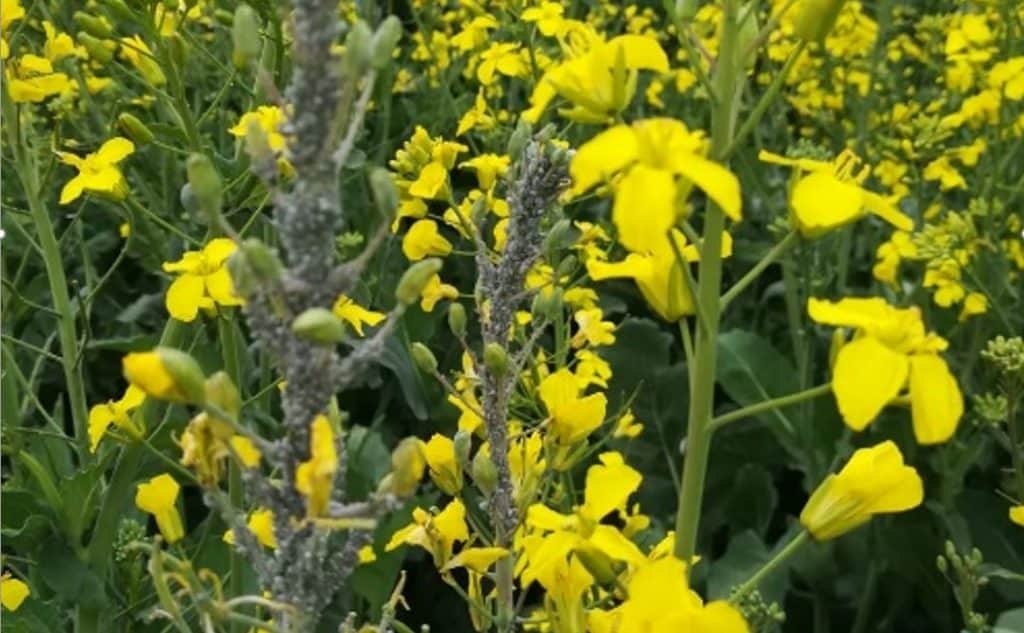
Know your enemy! This is the Mealy Cabbage aphid and it builds up in mucilaginous, dumbo colonies on the growing tips of your canola. The straight feeding damage causes yield loss – upward to 33% in 1 Australian trial I came across. Information technology is worse in dry conditions when the institute is struggling, then be enlightened of these quick, important points:
- The threshold for spraying with an insecticide – the betoken at which the damage causes an economic loss – is 20% of plants infected in Australia. In Europe information technology is 4%. I have no idea why there is a deviation, simply it gives you a broad idea that if you are seeing every couple of stems infected, do something about information technology.
- Watch how the population is building up over several days – this is arguably more important than the actual thresholds, because sometimes aphids increase so chop-chop that you can be too tardily in intervening. Other times beneficial insects such as Hover Flies are eating the aphids as fast as they build up, fugitive the need to spray.
- Pyrethroid insecticides are not very effective (east.g. lambda-cyhalothrin), and organophosphates such equally chlorpyrifos are very damaging to beneficial insects and the wider environs at this stage. Pirimicarb is far safer to other insects such as Bees, and the vapour activity means that coverage of the tight colonies is expert, giving high levels of command.
- When you apply the insecticide, aim for a fine spray quality to ensure good coverage.
Wheat After Canola
With a big reduction in the corporeality of barley planned for side by side flavour, in that location will be lots of situations where wheat is planted afterward canola. Canola is a fantastic pause crop that reduces Fusarium, Take-all and other soil borne illness, merely farmers often comment that wheat afterwards canola can struggle in the early stages compared to barley afterwards canola.
Canola can have a slight allelopathic effect in the soil (release of chemicals that slightly inhibit other plants), and it tin reduce nitrification in the soil. This should not put y'all off planting wheat behind last season's canola fields notwithstanding, equally the yields will still exist massively improved compared to successive wheat crops.
At that place are some elementary steps you can have to reduce the furnishings on the wheat:
Firstly get the nutrition right for the wheat. Exam your soil and make certain enough phosphate is available in the seedbed. If yous are intending to dry plant, brand certain that the fertiliser is dry planted too. Very often growers brand sure the seed is dry, but the fertiliser is placed only into moisture where information technology can start to lock up chop-chop as it reacts with atomic number 26 and aluminium.
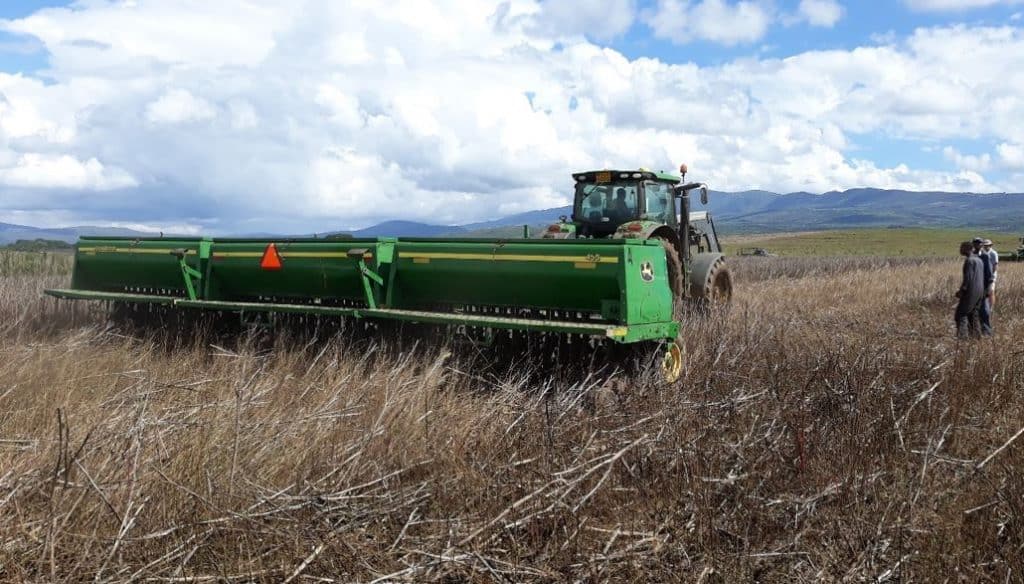
Secondly cultivate in expert time. Not for those practicing notill, only getting the canola residues to break down and ensuring the soil structure is good will actually help. The worst matter is disc ploughing, leaving a solid layer of canola residue in the dry and reinforcing any difficult pans in the soil that the wheat roots have to struggle through.
Apply a minor dose of early nitrogen at 2-3 leaf stage – don't go crazy, but xxx kg of nitrogen can help the ingather.
A embrace crop planted after the canola and ahead of the wheat, containing Sunflowers which are highly mycorrhizal, is cheap and helps the wheat access phosphate. It is very inexpensive, just be certain to terminate it 60 days after planting so information technology doesn't steal as well much moisture.
Till side by side time,
Happy farming!
David,
About David

David Jones is the Broad Acre Specialist at Ingather Nutrition Laboratory Services Ltd. (CROPNUTS). David has a keen involvement in soils and no till farming systems where he has undertaken work looking into weed levels and changes in soil structure, and has extensive experience in field trials and in the development of precision farming techniques. In his spare fourth dimension he enjoys playing rugby. Follow David on Twitter @Cropnuts_agron
Source: https://cropnuts.com/controlling-weeds-in-potatoes/
0 Response to "what to spray potatoes with to control weeds"
Enregistrer un commentaire