Cheryl Dunye the Potluck and the Passion Review
Pride Calendar month in 2020 has been loaded with activism, education, and word regarding Queer Black people, and an essential proper name to be added to this discourse is that of Cheryl Dunye. When I watchedThe Watermelon Woman — the get-go moving-picture show where a Black lesbian directed and starred — information technology felt similar abode. Never before had I seen a film that not but allowed Blackness women to play the dozens, squabbling in that familiar Black mode, but as well to put their lesbianism at the forefront without it succumbing to whitewashed generalizations that erase its Black.
In the opening scene of The Watermelon Woman, we see Cheryl and Tamara working a wedding for a White family. White people brand up a majority of the invitee list, only there is likewise a small grouping Black men donning suits, likewise as a single Black woman. They remain silent, but the shots pointedly focus on the wedding ceremony party, making it apparent who maintains the majority of those in attendance. In this surroundings, the wedding party ends upwards blending in with i another. In contrast, firmly posited into their Black, lesbian, and working class identities, Cheryl and Tamara immediately stand out.
The subtle definition of both the racial and grade divides depicted at the start of the picture serves as an avenue for Dunye to ensure that Cheryl and Tamara are at the forefront of this mockumentary. It permits the viewer to take liberties with fictionalizing their lives and status, while also rooting it in their breathy reality as working-grade Blackness lesbians. Cheryl's obsession with researching the "Watermelon Woman," the fictional Fae Richards, a Blackness mammy figure in a 1930s pic, mirrors the experience of Black lesbians watching Dunye'south ain pic of the aforementioned name. The Watermelon Womanwas fabricated ii years before I was born, then watching it feels like discovering an artifact, and the remastered version (constitute for free on the Criterion Channel until the end of June) reminds me that my own history, and the modern LGBTQ+ community, is not disconnected or exiled by time from the Queer experience of the past. But most of all, it evokes the fact that Black lesbians in detail still take not been able to claim the attention they deserve.
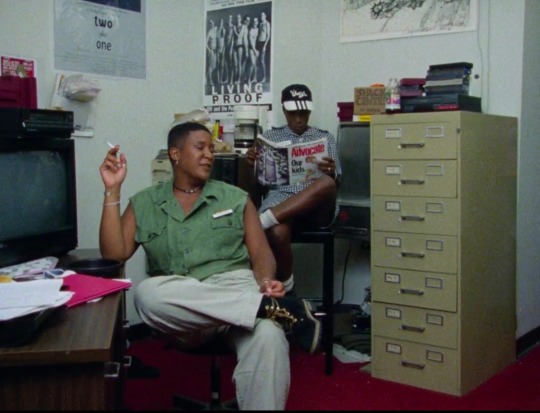
In his book, Black Bodies, White Gazes, George Yancy writes virtually the ways that Blackness is defined by whiteness. Blackness, and the scrutinizing eyes with which information technology is viewed, has get reliant on the white gaze. He writes, "the corporeal integrity of my Black body undergoes an onslaught equally the white imaginary, which centuries of white hegemony accept structured and shaped… I feel 'external,' as it were, to my body, delivered and sealed in white lies." Yancy's words are particularly evocative in the film as the photographic camera's lens acts as a way to ascertain the people on screen. In The Watermelon Woman, the setting is a place full of Black people, with White people only acting as extras or fulfilling the role of being foils to the narrative'due south master focus on Black characters. Whether it'due south people in line for the produce truck; other lesbians at the nightclub, purposely existing on the edges of the frame; Annie, their White, presumably lesbian co-worker; or Diana, Cheryl'due south girlfriend who is often seen in glimpses, rather than existing as a main facet of Cheryl's overarching story, sidelining Whiteness equally a means to amplify the Black lesbian experience is integral to the movie.
This thematic focus is also apparent in her series of shorts. In Vanilla Sex, she tackles the separation of the practices and understanding of lesbianism between Blackness and White lesbians. For White lesbians, vanilla referred to the practice of having sex activity without kinks or toys; for Black lesbians, it was a marker of having sex with White women. Vanilla Sexual practice puts this popular term into question and actively 'others' the white lesbian definition, as is oft washed to Black in any other context. Dunye flips this expectation of 'normalcy' around a community'southward term, puts the oppressed perspective in the vanguard, and demonstrates that there isn't a universal lesbian experience — Blackness will ever be an innate part of a Blackness lesbian'southward sexual identity. She does the aforementioned in Potluck and the Passion, a brusk that aims to exhibit the dynamic nature of lesbians, besides equally investigate the interrogations that Black lesbians face up from non only others, but themselves every bit well.
Dunye'southward signature dry out wit comes into play when they all mispronounce the name of Megan, the only White woman at the political party, flipping the script by alienating the only woman there who was not of colour. In fact, Megan comes to the party with her appointment, Tracy, who ends upwards having her Blackness challenged past Evelyn, another guest, who spends the night talking about the various Black cultural groups she is a part of. As the night progresses, this plotline stands out as Tracy ends upward finding much more in mutual with Evelyn, much to Megan'south disdain, as she is clearly only dating Tracy equally a manner to gain cultural upper-case letter.Potluck and the Passion puts white lesbians in the periphery, highlighting the love of Cheryl and Gail, and eventually, Evelyn and Tracy. There is a abiding tension within the Black members of the LGBTQ+ community, merely Megan demonstrates how White members frequently attempt to absolve themselves from their Whiteness through their queerness, undermining the Black experience in the process, as Blackness lesbians notice themselves at the intersection of gender, sexual, and racial oppression.
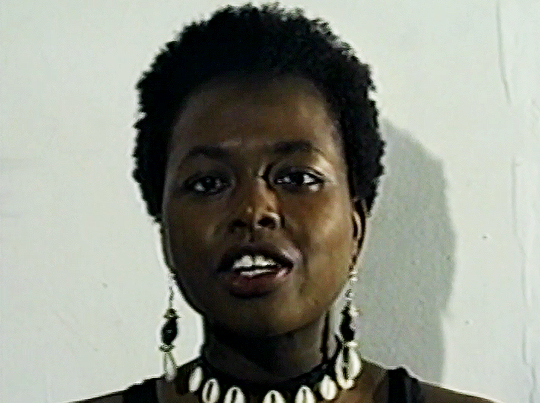
There is an importance in making seemingly mundane everyday happenings of Black lesbian life the principal plot of Dunye's piece of work. She Don't Fade is a prime number example. Information technology starts with a white woman who introduces the plot, saying the film might feel familiar because information technology "might even be your life." This is what makes Dunye'southward films so exalting: they are displays of our lives. For once, we have a Black lesbian telling her story without the pause or intrusion of a white narrative that attempts to universalize the inherently varied lesbian experience. This is similar to Janine, another one of her shorts, in which has Cheryl recounts a story of her human relationship with a White classmate. Cheryl takes accuse of the narrative, projecting her own voice and eliminating the need for whatever outside input. She refers to Janine as the "epitome of Whiteness" equally she is the White, wealthy, and blonde antithesis to Cheryl. Again, using a mockumentary style of filmmaking, Dunye creates a new space in which the Black working-course lesbian narrative is the preferred betoken of view. Janine is reduced to old photographs interpolated throughout Cheryl'southward shots of speaking directly to the photographic camera as she takes authorization over her identity and feel in maneuvering racial and queer tension.
Dunye's signature mockumentary manner, involving breaking the fourth wall equally a device of farther caption, reads as an invitation to empathise Black lesbians in real-life — to hear the chronicles of their experience from their own mouths. These plots may be fictionalized, merely the characters are representative of very real people who decline to be held within one stereotype and trope that shadows them from the rest of the community in an effort to closet their Blackness.
"While I recognize the historical power of the white gaze, a perspective that carries the weight of white racist history and everyday encounters of spoken and unspoken anti-Black racism, I do not seek white recognition, that is, the white adult female'southward recognition…I am non dependent upon her recognition…Rather, my preference is suggestive of my hope of a radically different world."
– George Yancy, "Black Bodies, White Gazes"
The reclamation of the Black lesbian narrative is not just what Cheryl Dunye strives for in her films, it'south what she accomplishes. Dunye creates a radically different world in which Black lesbians have an autonomous voice and storyline. Her movies exercise not enquire for permission from the White gaze or attempt to include explicitly White-driven narratives as guidance, but instead, exist entirely independently. Her merely dependence lies in being loyal to representing herself and other Black lesbians who carelessness the persistent idea that lesbianism is synonymous with Whiteness. Dunye is distinctly unique in this way, founding her fashion of films in laurels of Black lesbians who build worlds where our stories are equally paramount to the others within the LGBTQ+ community at large.

Source: https://filmdaze.net/cheryl-dunye-bringing-queer-blackness-to-the-forefront/
0 Response to "Cheryl Dunye the Potluck and the Passion Review"
Enregistrer un commentaire